 DHMA
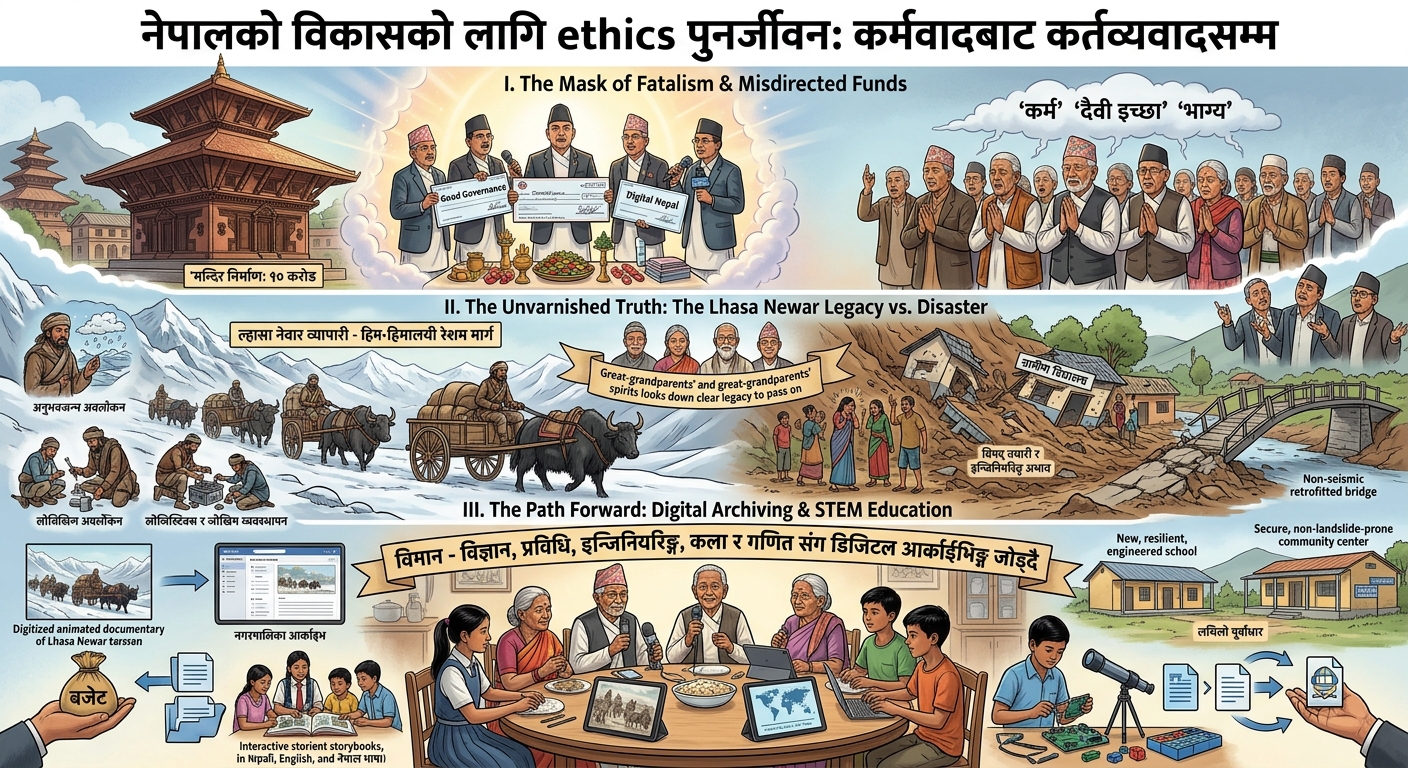
International Ethics Day: From Fatalism to Accountability
International Ethics Day reminds us that honesty, responsibility, and accountability are essential for any country’s progress. In Nepal, politicians frequently deliver grand speeches about “good governance” and “Digital Nepal.” Yet on the ground, reality tells a very different story.
Why do our roads wash away every monsoon? Why do many public schools still lack safe buildings and basic resources? The problem is not merely political. It also stems from how we think, how we interpret fate, and how we allocate public money.
Big Words vs. Real Action
In Nepal, leaders often speak eloquently about rules, development, and reform. However, when projects fail, responsibility is rarely assigned. Too often, officials hide behind fatalism, claiming, “It is our destiny,” or “It is God’s will.”
When citizens accept every systemic failure as mere fate, they are less likely to question authority, demand transparency, or track where public money goes. True governance requires citizens to ask difficult questions—and leaders to answer them honestly.
Disasters, Planning, and Public Spending
Lying in a seismically active region, Nepal faces recurring earthquakes, floods, and landslides. Addressing these threats requires science, sound engineering, strong institutions, and careful planning.
Following major disasters, including the 2015 earthquake and subsequent monsoon floods, serious concerns arose over whether relief and reconstruction funds reached those who needed them most. Citizens have a fundamental right to know how public funds are allocated, spent, and audited.
Public budgets must prioritize safe housing, resilient infrastructure, functioning schools, well-equipped hospitals, and disaster preparedness. While religious and cultural traditions hold an important place in Nepali society, they cannot substitute for engineering and accountability. Spending public funds on monuments or political pageantry while schools lack roofs and hospitals lack medicine sends the wrong message. Prayer may offer comfort, but it cannot pave a road, prevent a landslide, or replace a functioning public system.
Senior Citizens: Living Libraries
Our senior citizens are living libraries. They carry firsthand memories of hardship, migration, trade, family life, and community resilience. Rather than involving elders solely in ceremonial events or political gatherings, we should listen to their experiences and preserve their knowledge. Young people miss a vital opportunity when they fail to learn directly from their elders, whose stories offer timeless lessons in courage, cooperation, enterprise, and survival.
The Lhasa Newars: A Legacy of Resilience
When Nepali culture is viewed exclusively through temple rituals, we risk overlooking equally vital chapters of our history. One prime example is the legacy of the Lhasa Newars—also known as Lhasa Baniyas or Lhasa Sahu—the Newar merchants and artisans who traveled and traded between the Kathmandu Valley, Tibet, and India for centuries. Their history proves that Nepali heritage is built on hard work, technical skill, careful planning, and enterprise—not passive fatalism.
Crossing Dangerous Mountains: Traveling from Kathmandu to Lhasa required weeks of perilous trekking across high Himalayan passes, including the Kuti and Kerung routes. Traders braved extreme cold, blizzards, altitude sickness, treacherous terrain, and banditry. They survived not by blind luck, but through rigorous preparation, deep knowledge of weather and terrain, physical endurance, and teamwork.
Trade, Logistics, and Enterprise: Lhasa Newar merchants built sophisticated commercial networks linking Nepal, Tibet, and India. They transported metalware, textiles, and spices northward across the Himalayas, returning with wool, salt, gold, and medicinal herbs. Their success relied on market intelligence, supply-chain logistics, relationship-building, and adaptability amid shifting geopolitical conditions.
Accounting, Cooperation, and Community: Operating businesses in a foreign land demanded sharp numerical skills, meticulous bookkeeping, and mutual trust. Traders navigated multiple currencies, maintained detailed ledgers, negotiated complex contracts, and leaned on tight-knit community networks. They established guthis (community trusts) and trade associations to support one another, mediate disputes, and weather crises. The formation of the Nepalese Chamber of Commerce in Lhasa in 1943 stood as a testament to their organized commercial strength.
Craftsmanship and Adaptation: Beyond commerce, Newar artisans enriched the region through architecture, metalwork, and cultural exchange, demonstrating a deep tradition of technical mastery. When geopolitical shifts altered traditional trade routes in the mid-twentieth century, many Lhasa Newar families adapted—returning to Nepal to invest their capital, business acumen, and international networks into new ventures at home. Elders from these families still remember ancestors who calculated risks, managed complex finances, and built cross-border enterprises without modern state support. These stories must be recorded before they disappear.
The Danger of Dogma
Real danger arises when religious or cultural dogma replaces curiosity, education, and independent thought. A thriving society requires:
Scientific curiosity: A willingness to understand the world through observation, evidence, and testing.
Lifelong learning: Education that encourages inquiry rather than blind conformity.
Independent judgment: Critical thinking that protects citizens from political or social manipulation.
Constructive reflection: The wisdom to preserve valuable traditions while reforming harmful practices.
Faith and culture can foster community and meaning, provided they inspire compassion, honesty, and responsibility rather than fear or unquestioned obedience.
From Temples to Digital Archives
We must rethink our public spending priorities. Instead of pouring excessive funds into ceremonial projects, Nepal should invest in education, research, practical skills, and digital preservation. Building digital archives can safeguard the memories of our elders while generating meaningful local employment. With basic training and accessible tools, young people can document the lives of their grandparents and great-grandparents through:
Audio and video oral histories: Recording elders recounting stories of migration, trade, hardship, and resilience.
Digital books and documentaries: Using modern transcription and AI-assisted translation tools to produce accessible books, subtitled videos, and documentaries in Nepali, Nepal Bhasa, English, and other local languages.
Youth digital-storytelling training: Equipping students with recording gear and teaching them interviewing, archiving, and multimedia production skills.
Community knowledge hubs: Empowering local schools, libraries, and municipalities to curate and share these archives responsibly.
The Kitchen Table and STEAM Education
Lasting cultural change often begins around the kitchen table, where parents and grandparents pass down values and lived wisdom. When families pair ancestral stories with STEAM education (Science, Technology, Engineering, Arts, and Mathematics), children gain both historical grounding and modern problem-solving skills.
By learning how their forebears engineered trade routes, managed risk, and thrived in harsh climates, young Nepalis can stop waiting on fate—and start using science, creativity, and critical thinking to build a better country.
A Heritage of Courage and Critical Thinking
Good governance is not a gift bestowed by gods or politicians; it is built by active citizens who demand truth, evidence, accountability, and genuine public service.
International Ethics Day is more than a date on the calendar—it is a call to recognize that a nation’s future is shaped by the daily choices of its leaders and citizens. Nepal does not need more empty promises or fatalistic excuses; it needs transparent governance, scientific planning, quality education, and respect for its elders' practical wisdom. By preserving the real stories of the Lhasa Newars, farmers, artisans, and workers, and by investing in digital archives and STEAM education, Nepal can turn its rich heritage into modern strength. When we replace passivity with courage and accountability, tradition and progress can work hand in hand to build a fairer, stronger, and more prosperous nation.