 DHMA
Needs in the Age of AI
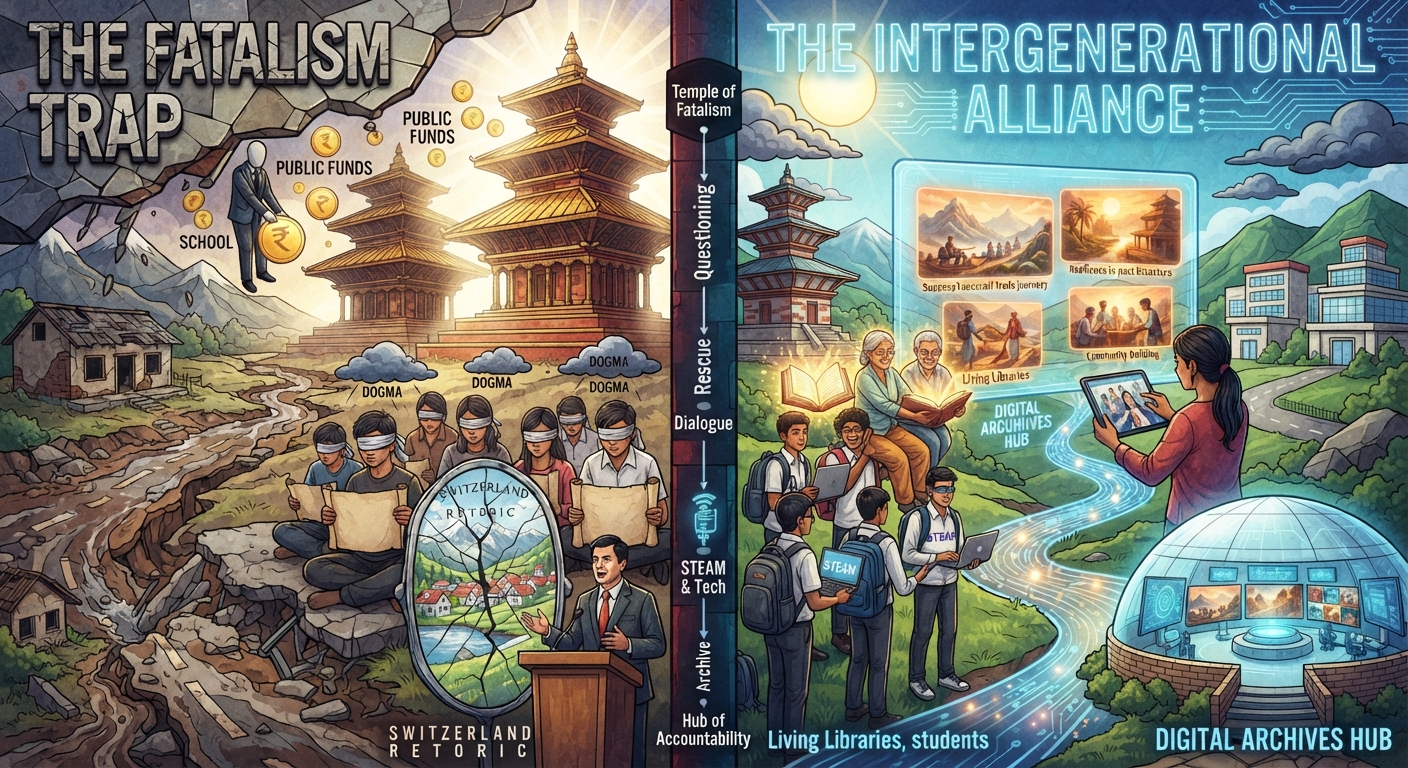
For decades, Nepali politicians have promised to turn Nepal into "Switzerland." Yet instead of investing in the precision engineering, geological safety, and scientific discipline that actually built Switzerland, they compete with one another to renovate stone temples and fund endless public rituals.
In the age of artificial intelligence, this misplaced priority is not merely wasteful—it is dangerous.
Disaster Aid vs. The Competition to Build Temples
Nepal sits in an active seismic zone plagued by deadly floods and landslides. After the 2015 earthquake, the Rasuwa floods, and every major disaster since, ordinary people around the world donated their hard-earned money to help vulnerable Nepali communities rebuild their lives. Yet instead of safeguarding human lives, citizens watch vast sums of public money poured into temple renovations and political pageantry. Meanwhile, disaster survivors still struggle, village schools lack safe roofs, rural hospitals lack basic medicine, and mountain highways wash away every monsoon.
Why is there such fierce political competition to build monuments and stage rituals? Because ceremonies demand zero accountability:
Keeping the Next Generation Passive: Encouraging young people to sit passively, chant mantras, and memorize dogma that offers no solutions in an AI-driven world fosters an obedient electorate—one less likely to ask where disaster relief vanished or why roads collapse every rainy season.
Trading Engineering for Superstition: You cannot stabilize a mountain slope or stop a flash flood with a prayer. Surviving earthquakes and Rasuwa-style floods in the twenty-first century requires geological mapping, early warning systems, climate science, and AI-driven risk modeling—not blind fatalism.
Ceremonial spending on monuments and rituals can wait until Nepal actually achieves Swiss standards of safety and prosperity—when every village has disaster-resilient schools, reliable roads, modern hospitals, and thriving scientific institutions. Until then, every rupee must go toward saving lives and building real human capability.
Senior Citizens: Temple PR vs. Living Libraries
Our senior citizens are living history books. They remember who misappropriated public funds, how past communities survived crises, and why earlier development projects failed. Rather than learning from them, local politicians routinely escort elders to temple gatherings simply to chant slogans and pose for campaign photos funneling public funds to temple committees to secure older voters' loyalty, keeping elders occupied with ceremonial roles so they do not ask hard questions about missing development budgets and breaking and depriving young people of the chance to absorb practical, real-world wisdom from their grandparents.
The Intergenerational Powerhouse: Elders Meet Tech-Savvy Youth
When we rescue our elders from political temple shows and connect them directly with tech-savvy university students and documentation specialists, we unlock an intergenerational alliance capable of transforming both generations and the nation.
Young people miss an irreplaceable opportunity when they fail to learn directly from their elders, whose lived experiences offer timeless lessons in courage, cooperation, risk management, and enterprise.
The Lhasa Newars: Proof That Nepali Heritage Is Built on Enterprise
When Nepali culture is defined exclusively through temple rituals, we erase some of the most dynamic chapters of our own history. A prime example is the legacy of the Lhasa Newars—also known as Lhasa Baniyas or Lhasa Sahu—the Newar merchants and artisans who traveled and traded across the Kathmandu Valley, Tibet, and India for centuries.
Their history proves that Nepali heritage rests on technical skill, rigorous planning, and enterprise—never passive fatalism:
Crossing Dangerous Mountains: Traveling from Kathmandu to Lhasa required weeks of perilous trekking across high Himalayan passes, including the Kuti and Kerung routes. Traders braved sub-zero blizzards, altitude sickness, treacherous terrain, and banditry. They survived not by blind luck, but through careful preparation, deep knowledge of weather and geography, physical endurance, and teamwork.
Trade, Logistics, and Enterprise: Lhasa Newar merchants built sophisticated commercial networks linking Nepal, Tibet, and India. They transported metalware, textiles, and spices northward across the Himalayas, returning with wool, salt, gold, and medicinal herbs. Their success depended on market intelligence, supply-chain logistics, relationship-building, and adaptability amid shifting geopolitical realities.
Accounting, Cooperation, and Community: Operating businesses in a foreign land demanded sharp numerical skills, meticulous bookkeeping, and mutual trust. Traders navigated multiple currencies, maintained detailed ledgers, negotiated complex contracts, and leaned on tight-knit community networks. They established guthis (community trusts) and trade associations to support one another, mediate disputes, and weather crises. The formation of the Nepalese Chamber of Commerce in Lhasa in 1943 stood as a testament to their organized commercial strength.
Craftsmanship and Adaptation: Beyond commerce, Newar artisans enriched the region through architecture, metalwork, and cultural exchange, demonstrating a deep tradition of technical mastery. When geopolitical shifts altered traditional trade routes in the mid-twentieth century, many Lhasa Newar families adapted—returning to Nepal to invest their capital, business acumen, and international networks into new ventures at home.
Elders from these families still carry memories of ancestors who calculated risks, managed complex finances, and built cross-border enterprises without modern state support. These stories must be documented before they vanish.
Rejecting Dogma in Favor of Critical Inquiry
Real danger arises when religious or cultural dogma replaces curiosity, education, and independent thought. A thriving society requires:
Scientific curiosity: A willingness to understand the world through observation, evidence, and testing.
Lifelong learning: Education that rewards inquiry rather than blind conformity.
Independent judgment: Critical thinking that protects citizens from political and social manipulation.
Constructive reflection: The wisdom to preserve valuable traditions while reforming harmful practices.
Faith and culture can foster community and meaning, provided they inspire compassion, honesty, and responsibility rather than fear or unquestioned obedience.
From Temples to Digital Archives and STEAM Education
We must redirect public spending from ceremonial monuments toward education, research, practical skills, and digital preservation. Partnering university students with senior citizens to build digital archives safeguards our living history while generating meaningful local employment. Equipped with basic training and accessible AI tools, young Nepalis can document the lives of their grandparents and great-grandparents through:
Audio and video oral histories: Recording elders recounting stories of migration, trade, disaster survival, and resilience.
Multilingual digital books and documentaries: Using modern transcription and AI-assisted translation tools to produce accessible books and subtitled documentaries in Nepali, Nepal Bhasa, English, and other local languages.
Youth digital-storytelling fellowships: Training university and high-school students in interviewing, archival ethics, and multimedia production.
Community knowledge hubs: Empowering local schools, libraries, and municipalities to curate and share these archives openly.
Lasting change also begins around the kitchen table. When families combine ancestral stories with STEAM education (Science, Technology, Engineering, Arts, and Mathematics), children gain both historical grounding and modern problem-solving skills. By learning how their forebears engineered trade routes, managed risk, and thrived in harsh climates, young Nepalis can stop waiting on fate—and start using science, creativity, and critical thinking to build a safer nation.
A Heritage of Courage and Accountability
Good governance is not a gift bestowed by gods or politicians; it is built by active citizens who demand truth, evidence, transparency, and genuine public service. Nepal does not need more empty "Switzerland" slogans, performative temple politics, or fatalistic excuses. It needs honest leadership, scientific disaster planning, quality education, and deep respect for its elders' practical wisdom. By uniting the lived experience of our senior citizens with the technological fluency of our youth—and by investing in digital archives and STEAM education—Nepal can turn its rich heritage into modern strength. When we replace passivity with courage and accountability, tradition and progress can work hand in hand to build a safer, fairer, and more prosperous nation.