 DHMA
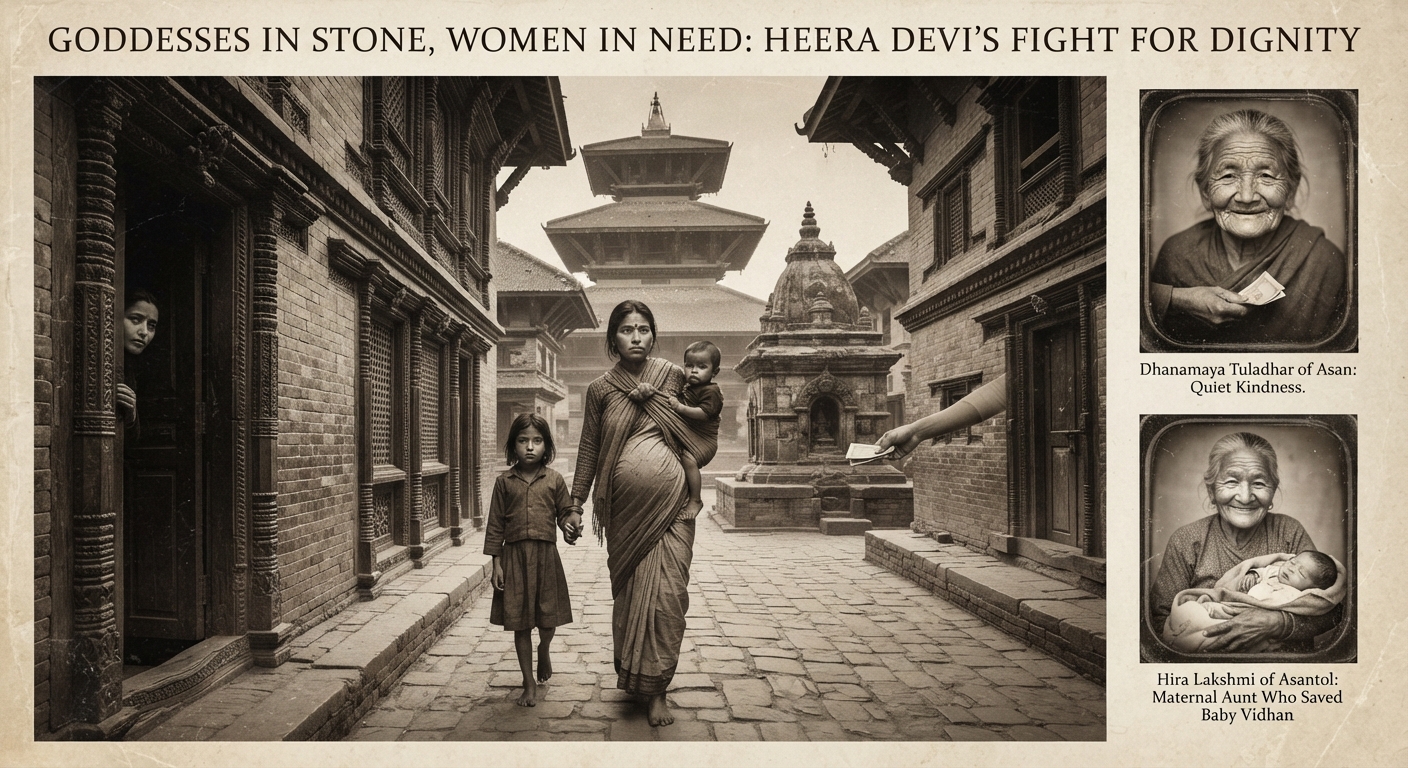
Goddesses in Stone, Women in Need: Heera Devi’s Fight for Dignity
The Lasting Legacy of Heera Devi Yami: A Mother, A Patriot, and A Pillar of Kathmandu Valley
Kathmandu Valley has many famous temples and courtyards where people pray to goddesses of strength, protection, and motherhood. Yet during the harsh years of Rana rule, people lived in deep fear. Rumors and scare tactics spread through the city. Many frightened people held tightly to temple idols and performed endless religious rituals to stay safe, while turning away from real women who showed true courage by standing up for fairness and human dignity.
One of those brave women was Heera Devi Yami. Her story should never be forgotten. She never went to school as a child, yet her own life became her university—every hardship taught her deep lessons in bravery, clear thinking, and leadership. As a mother, she held her family together and kept a freedom movement alive when almost everyone else was afraid to step outside.
Fear After 1997 B.S. and Standing Completely Alone
In 1997 B.S. (1941 A.D.), the Rana rulers publicly executed four freedom fighters—Dharma Bhakta Mathema, Gangalal Shrestha, Shukraraj Shastri, and Dasharath Chand—in front of crowds in Kathmandu Valley. Officials urged ordinary people and poor families across the city to go look at Dharma Bhakta Mathema's hanging body so fear would enter every home.
Shaken and afraid, people returned to their neighborhoods repeating what the rulers wanted them to believe: that killing the four men in public was a fair punishment, that anyone speaking against the government deserved the same death, and that fighting for freedom was "nonsense." Instead of asking for justice, many neighbors told one another to stay quiet, pray to goddesses, perform rituals, and leave everything to God.
Afraid to walk on the roads, people stayed indoors. There were no other women standing alongside Heera Devi when she handled these grave situations all alone alongside the male underground activists—quietly carrying messages and support between jailed fighters, people in hiding, and their families.
False Stories and Cruel Words in the Streets
To break her spirit and turn the whole community against her, the rulers spread false stories and lies about the freedom movement. Because fear kept other women at home, ruining Heera Devi's good name became a main weapon to push her down.
Whenever she walked through the city to help prisoners and their families, some shopkeepers shouted cruel insults and bad words at her from their shops. Inside homes, some women spoke badly about her too. In those days, girls and women faced the real danger of being kidnapped, so a woman walking alone on the street was wrongly judged and shamed. Rulers used lies, public insults, and social shame to make society reject her completely. Even when people threw harsh words at her face, she did not back down.
Hunger in Exile and the Birth of Dharma Devi
Before becoming a public voice in Kathmandu, Heera Devi faced hard days in exile across the border in Raxaul and Madhubani, Bihar. While her husband worked secretly against Rana rule, she stayed at the Gandhi Mahila Ashram in Madhubani during her first pregnancy. Food was very scarce there. Because she was pregnant and could not push through crowds for small food shares, she often went hungry and became very thin and weak.
Still carrying her baby, she made the hard trip back to Nepal and gave birth to her first daughter, Dharma Devi, while facing poor health, little food, and constant danger.
Building Trust Through Secret Teaching, Tibetan Wool, and Quiet Home Visits
After returning from Madhubani and Raxaul, Heera Devi began carefully rebuilding trust within the frightened community. During the Rana regime, education for ordinary citizens was strictly forbidden, and teaching became an act of quiet defiance. Master Jagat Lal of Masan Galli, who was running an underground school in secret, passed a copy of the Royal Reader—an English textbook imported exclusively for the children of the Rana rulers—to Heera Devi. Meanwhile, when large numbers of underground activists were arrested and imprisoned, the jail inmates arranged for her to teach at Buddhi Bikas School, tucked behind the Hanuman Mandir near Hanuman Dhoka, as well as in the neighborhood next to Shanti Nikunja High School in Maru Tole.
Using the Royal Reader, Heera Devi gathered children from the neighborhood—including the children of farmers and marginalized Dalit ("untouchable") families—and taught them English in secret. Because families had little cash, students brought basic foodstuffs from home as their tuition—provisions that became a vital lifeline to feed underground activists and their starving families. As mothers saw their children learning and cared for, they slowly began to trust Heera Devi and believe in her work.
To bring women together safely and help them stand on their own feet, she also organized local women around practical livelihood skills. Using her access to wool brought from Tibet, she taught women how to knit wool and stitch blanket covers, among other crafts, so they could earn an independent living. Through these knitting circles, she gradually built a trusted network of women whom she could quietly mobilize for movement activities. At the same time, she visited the homes of imprisoned political leaders' wives—women who were also in deep trouble and distress, yet too terrified to step out into the streets during a crisis.
Keeping her school and network alive meant enduring constant danger and hostility. Authorities threatened the organizers to abandon the school, and opponents even brainwashed the children to turn against Heera Devi's teaching so that she could be forced out. To keep the lessons going undetected, the children had to be moved secretly from one courtyard to another, seeking out dim, hidden corners with minimal light. Life was extraordinarily hard, sustained only by Heera Devi's resilience and determination to bring education and self-reliance to the community while keeping the democratic movement alive.
Blessings at Bhugol Park and Arrest at Maru Tole
In those days, women in Kathmandu were often scared even to look out of their windows because of the danger of abduction. Still, Heera Devi stepped forward again and again. Famous Nepali writer Vijay Bahadur Malla wrote in Smriti Grantha that every year on Dashami, when he put tika on people's foreheads, he remembered Heera Devi Aama at Bhugol Park. At a protest there—while she was pregnant with her son Vidhan and no other woman stepped forward—she walked up as the program started, put flower garlands on the leaders, and put tika on their foreheads. Right after that, government forces attacked and arrested the protesters.
On India's Independence Day in August 1947, she led a brave march through Kathmandu carrying a banner that read "Ram Ram, Ram Ram, Ram Ram." The march reached Kasthamandap in Maru Tole, where a stage held a picture of Mahatma Gandhi. Standing before a large crowd of men—the first woman in Nepal to speak at such a public event—she held her baby on her lap. The moment she started speaking, Rana forces arrested her right there with her baby in her arms. Newspapers in India soon reported her brave stand.
A Cramped Space and Harsh Conditions in Jail
After her arrest, Heera Devi and her baby were locked in a Rana jail in harsh conditions. There was no separate room for women, so she was kept in the same room with male prisoners. Her space was like a tight box with almost no privacy, fresh air, or comfort for a mother nursing a baby. Worse still, open, dirty toilets sat right next to the room—swarming with bugs—where she and the men were kept, bringing terrible smell, filth, and daily shame. Even there, she stayed strong for a freer future.
Founding the Nepal Women's Association (22nd Bhadra 2004 B.S.)
With the underground movement heavily watched and political prisoners worried that the struggle could not continue, Heera Devi stepped into a crucial leadership role. Though she had never sat in a classroom as a child, she was a keen observer—having witnessed how underground resistance worked in India, she understood how to organize quietly under strict watch. Having also lived in Calcutta in her early days, she had witnessed Gandhi's movement firsthand, which sharpened her understanding of the nuances of Nepalese politics.
On 22nd Bhadra (2004 B.S. / August 1947), a heavy downpour was chosen on purpose so CID agents and Rana spies would have no clue what was happening. Women and children secretly met first at Prem Bahadur Kansakar’s residence in Masan Galli, Kel Tole, to avoid surveillance from the regime. From Kel Tole, the women moved to the secluded Mhepi (Mhayepi) Temple and Jungle area to hold a picnic (Ban Bhoj), where they formally resolved to establish Nepal's first women's organization, the Nepal Women's Association (Nepal Mahila Sangh). Everyone took great care that no word of this historic beginning would leak out, and the photograph taken in Mhepi jungle that day had to stay hidden until 1951, showing how dangerous every step of organizing women truly was.
Keeping the Movement Going After Vidhan’s Birth (1st of Magh 2005 B.S.)
Around the time her son Vidhan Ratna Yami was born on the 1st of Magh, Vikram Samvat 2005 (January 14, 1949 A.D.), the rulers arrested almost all the activists and put them in jail, leaving almost no underground members outside. Those in prison worried the movement would stay silent for years.
Yet secret work kept happening at night across Kathmandu. Worried that the resistance was still alive, the rulers sent CID intelligence workers to find out who was running things outside. They learned it was Heera Devi Yami, who had taken on the whole task of keeping the underground movement going while the men were locked up.
Arrested While Bleeding and Outsmarting a Month of Interrogation
When police came to arrest her on the 1st of Magh, she was weak and still bleeding after giving birth. Too weak to walk, she was carried away in a container (doli or basket litter) toward jail. Seeing blood on her sari, officials realized how fragile she was and placed her under house arrest instead.
Even under house arrest, she was treated harshly. Kept on the cold ground floor outside her living quarters in winter, she was ordered to undergo a full month of rigorous interrogation—standing on her feet all day in Kathmandu's freezing cold while still healing from childbirth. Interrogators bombarded her with mental abuse, demanding the secret names and plans of every underground activist and suspect. To break her, they even brought prisoners in heavy chains and shackles right in front of her while she stood holding newborn Vidhan and her toddler daughter Dharma Devi.
Heera Devi turned her quick wit into a shield to protect her fellow freedom fighters:
Speaking Only Nepal Bhasa: She pretended she could not understand the Nepali language at all and answered every single question strictly in Nepal Bhasa (Newari). Because local Newar residents were too terrified of Rana punishment to step forward, officials struggled desperately to find a reliable interpreter who could translate accurately between Nepal Bhasa and Nepali—buying her precious time and blunting complex traps.
Using Her Children's Cries to Disrupt Questioning: Knowing that a slip of the tongue could cost lives, she deliberately brought toddler Dharma Devi on an empty stomach many mornings so that by noon the hungry child would burst into loud crying. Whenever the questioning grew especially sharp or dangerous, she would even gently pinch newborn Vidhan so both her son and daughter wailed loudly at once—irritating the interrogators, breaking their concentration, and preventing vital underground secrets from ever escaping her lips.
Severe Illness, Rumors of Dharma Ratna’s Death, and a Disguised Night Visit
After enduring a full month of grueling interrogation in the freezing cold, both Heera Devi and newborn Vidhan fell dangerously ill. Weakened beyond measure, Heera Devi would frequently faint and lose consciousness, yet whenever she opened her eyes, she kept her gaze fixed on her critically ill son. Vidhan suffered from a severe intestinal infection, constantly passing infected stool until his tiny body was completely drained and reduced to skin and bones—looking like a fragile skeleton.
During this terrifying period, her husband Dharma Ratna Yami was deep underground, and dark rumors reached Heera Devi that the Rana regime had already killed him without leaving a trace. Just after Vidhan's birth, Dharma Ratna had risked his life to visit the house one night disguised as a village farmer—wearing peasant clothes and carrying a large sack of vegetables and food grains on his back. To stay hidden from watchful eyes, he slipped inside a large traditional wooden grain container (kepa) for the night and escaped quietly early the next morning. After that night, he vanished completely without word, fueling widespread rumors that he had been murdered—leaving Heera Devi to battle severe illness, nurse her skeletal infant son, and endure crushing uncertainty all alone.
Heartbreaking Choices: Carrying Food to Jails While Her Children Cried Alone
With almost all the male leaders behind bars during waves of arrests, Heera Devi shouldered the heavy burden of coordinating underground operations outside while also delivering food to Dharma Ratna Yami, fellow inmates at Nakhu Jail and Bhadrakali Jail, and their struggling families.
Because CID agents ruthlessly beat anyone who tried to look after her young children, neighbors were far too terrified to step forward and help. Left with no choice at such a vulnerable time, Heera Devi had to leave a clay pot (khora) and some basic food inside her room and lock little Dharma Devi and toddler Vidhan Ratna indoors while she went out to carry on the movement's urgent work. All day long, the two small children would cry inside the locked room, relieve themselves in the clay pot, cry themselves to sleep, and wake up crying again. At times, when young Vidhan Ratna—who had only just learned to walk—stepped outside, he even fell into open neighborhood drains because no one dared come near to watch over him.
Solving Conflicts Across Kathmandu, Lalitpur, and Bhaktapur
Toward the late 1940s, before democracy arrived in 1950, keeping the movement alive grew harder not only because of police pressure, but because underground workers had strong disagreements and conflicts among themselves. Without formal schooling or degrees, Heera Devi drew on the wisdom she had earned through hardship to bring peace and order when arguments risked breaking the group apart.
Today, elders over age eighty-five living in poorer neighborhoods of Kathmandu, Lalitpur, and Bhaktapur still talk about what she went through alone before 1950. They remember her not just as a wife or a mother of seven children, but as a wise, sharp-minded problem solver who calmed disputes among activists and helped hold the movement together when it could easily have fallen apart.
Setting the Historical Record Straight: The 2046 B.S. Testimony of 99 Witnesses
During Vikram Samvat 2046 (1989–1990 A.D.), 99 contributors gathered to document the life and works of Dharma Ratna Yami. Although many of them also wanted to write extensively about Heera Devi Yami, the committee’s specific mandate was to focus on Dharma Ratna Yami.
In publishing the compilation of articles by those 99 contributors—a distinguished group comprising former prime ministers, writers, political leaders, and social workers—they underscored a crucial historical truth: before the advent of democracy in 1951 (2007 B.S.), women were far too frightened to appear physically on the streets during moments of crisis, leaving Heera Devi to stand entirely alone as she shouldered immense risks and resolved conflicts within the movement. In contrast, many later books and accounts written by self-proclaimed early political women leaders claim that they carried out extensive public activities during that perilous period. Yet according to the firsthand testimony of those 99 contemporary witnesses, no such street-level activities ever took place on their part—those narratives are merely later fabrications.
Quiet Night Work While CID Watched
One of Heera Devi's greatest acts of care happened out of sight to keep wanted activists safe. In those days, homes had no indoor toilets, and people used open areas. Activists hiding in safe houses could not go out in daylight, so they used clay pots (khora) to relieve themselves, brush their teeth, and wash their faces before slipping away early in the morning.
Because CID agents watched the neighborhood closely, throwing out a large amount of waste in daylight would show that several people were hiding inside. Night after night, with deep humility, Heera Devi bent her back like an old woman and quietly carried the heavy pots in the dark toward the riverside to empty them without being caught. While many prayed to goddesses in temples, this living mother did hard, dirty, risky night work so the freedom movement could survive.
Walking with Young Children in Danger
Elders over eighty-five in Kathmandu, Lalitpur, and Bhaktapur also remember seeing her walk through streets and courtyards during her risky third pregnancy. Even when fear and gossip made people afraid to look at her or talk to her, they saw her keep moving forward. She carried her two-year-old son Vidhan Ratna on her back, held the hand of her five-year-old daughter Dharma Devi, and carried her third child Timila in her womb—putting her own health and her unborn baby at serious risk.
Closed Doors and Two Kind Women
Because people were so frightened of punishment and rumor, some relatives and acquaintances shut their doors when Heera Devi sought shelter or help during secret work; some would not even offer food. That contrast shows how easy it is to honor goddesses in stone while turning away from a real mother in trouble.
Two women chose kindness over fear and helped her family get through:
Dhanamaya Tuladhar of Asan: Seeing how hard life was for a pregnant freedom fighter caring for two young children, she quietly gave Heera Devi money for food without asking for thanks or attention.
Hira Lakshmi of Asantol: After Heera Devi lost her own mother at age seven, her aunt Hira Lakshmi cared for her like a mother. When newborn Vidhan Ratna became very sick and doctors feared he might not live, Hira Lakshmi secretly took the weak baby home and nursed him back to health.
Why Her Story Matters in the Age of Artificial Intelligence
Today, in the age of artificial intelligence, machines can process data and answer questions in seconds—yet technology can never replace human empathy, moral courage, or the hard-won wisdom gained by standing beside suffering people. In a rapidly changing digital world, society needs leaders with the resilience, clear judgment, and selfless spirit of Heera Devi Yami more than ever.
Her life proves that true wisdom does not come only from classrooms or machines—every trial she faced became a teacher that shaped her into a perceptive leader. That is why storytelling must be encouraged in our homes, schools, and communities: so that future generations remember, honor, and carry forward the courage of Heera Devi Yami, along with the everyday kindness of Dhanamaya Tuladhar and Hira Lakshmi, building a world where no woman standing for justice and no mother caring for her children is ever abandoned.